
Takes, tags, and when to actually rewrite the prompt
Most bad AI sounds are not bad prompts - they are the wrong iteration move. When to ask for another take, when to steer with tags, when to rewrite, and when to blend two sounds instead.
Watch someone use a generative tool for an hour and you will see the same failure loop: type a prompt, dislike the result, rewrite the whole prompt, dislike that too, rewrite again. Every iteration throws away everything the previous one got right.
AI Synthesizer gives you four different iteration moves, and they are not interchangeable. Knowing which one to reach for is most of the skill.
The cheapest move: another take
Every generation returns several takes of your prompt. When the character is right - it is clearly the warm bass you asked for, just not quite the one - the answer is another take, not another prompt. Same words, fresh interpretation.
This is the move people skip because it feels passive. It is actually the highest-yield one: the prompt already encodes your intent, and takes explore the space around it for free.
The middle move: steer with tags
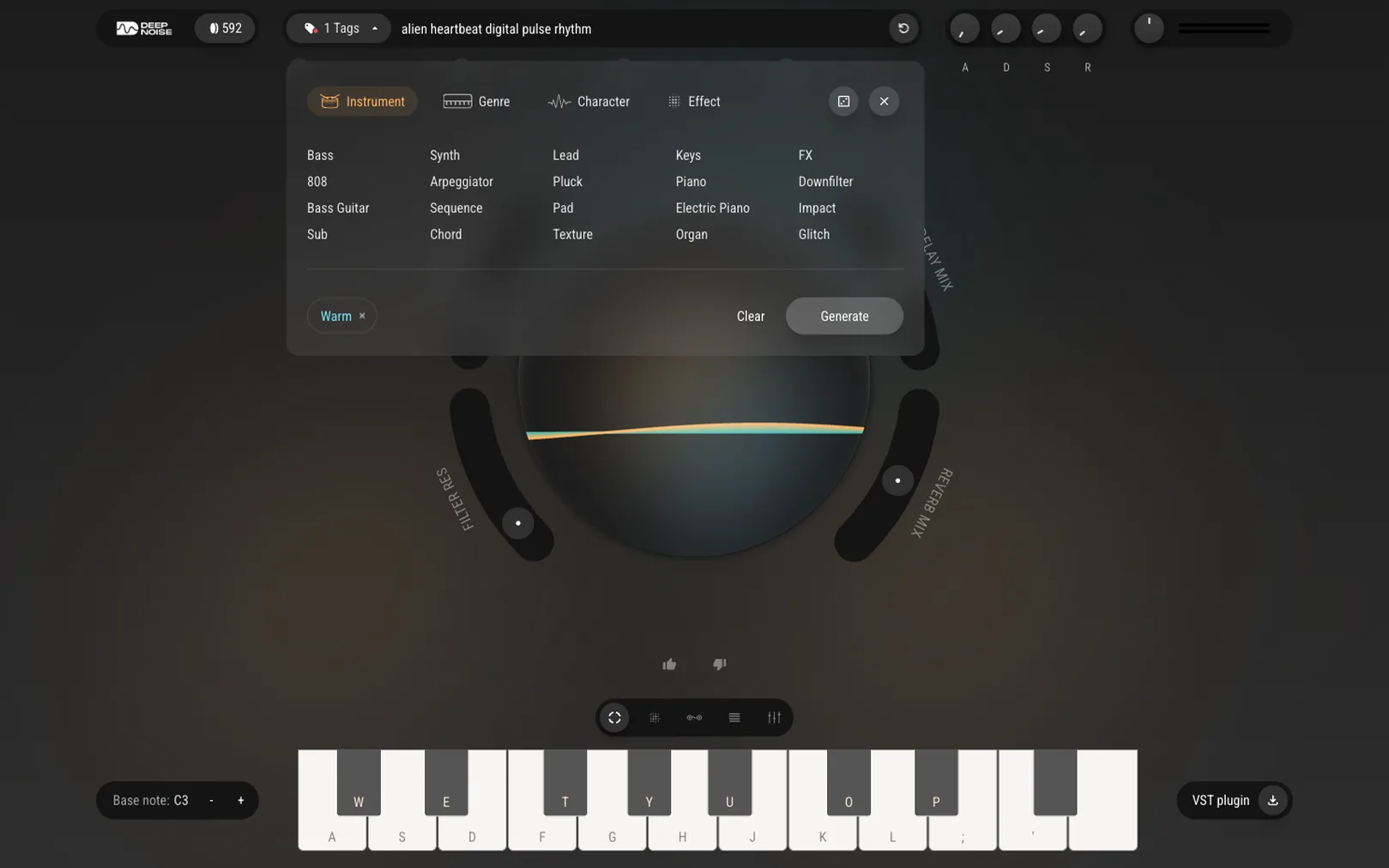
When the sound is right but the style is wrong, add tags instead of rewriting. Genre, mood, and style tags push a sound toward what you are hearing without disturbing what already works. A pad that is too polite gets a darker mood tag; a pluck that is too clean gets pushed toward lo-fi.
Think of the prompt as the noun and the tags as the adjectives you can swap without touching the noun.
The expensive move: rewrite the words
Rewrite only when the character is wrong - you asked for a pad and you are hearing a lead, or the words were feelings (“epic”, “emotional”) rather than sounds. Then change the instrument family or the texture word, not the punctuation. One concrete word is worth five atmospheric ones.
If you find yourself rewriting a third time, stop and check: is the character actually wrong, or were the last two takes just unlucky? Most third rewrites should have been takes.
The secret move: blend two sounds
Sometimes two takes are each half right. You do not have to choose: the mixer crossfades any two of your sounds into one, and the novelty control morphs a genuinely new texture out of the pair rather than just layering them. When a decision between two good options is taking longer than a blend would, blend.
A loop that works
- Prompt in plain words: family + texture + context.
- Audition every take before judging the words.
- Right character, wrong style: tags.
- Wrong character: rewrite the one word that is lying.
- Two half-right sounds: blend them.
- Close enough: stop generating and finish it in the effects chain.
Main claim: Iteration in AI Synthesizer is a ladder, not a loop: take, then tags, then rewrite, then blend. Reaching for the rewrite first is the one move that throws away everything the prompt already got right.
Try AI Synthesizer
Describe a sound and play it seconds later - free in your browser.
Try AI SynthesizerFrequently asked questions
Why does the same prompt give different results?
By design. Each generation returns several takes - fresh interpretations of the same description - so you choose between options instead of hoping one answer lands. Same words, different take, is the cheapest iteration move you have.
Do tags replace the prompt?
No, they steer it. The prompt names the sound; genre, mood, and style tags push that sound toward a scene or feel without changing what it fundamentally is. Character comes from the words, styling comes from the tags.
What does a generation cost?
One credit per generation, and every generation returns several takes. The free Starter plan includes 40 one-off credits; Creator and Pro include 600 and 1500 credits per month.